What Is a Clipping Company? The Complete Guide

If you've ever scrolled through TikTok, Instagram Reels, or YouTube Shorts and wondered what is a clipping company and how these mysterious organizations operate, you're not alone. The term "clipping company" has evolved dramatically—from a century-old media monitoring bureau into a multi-million-dollar marketing powerhouse that fuels the biggest names in entertainment, fintech, and beyond.
In this comprehensive guide, we'll break down everything you need to know about clipping companies: what they are, how they make money, the key players dominating the industry, and why they've become essential for brands and creators alike.
What is a clipping company? The core definition
A clipping company (also known as a clipping agency or clipping service) is an organization that provides media-related services to clients. However, the definition has split into two distinct meanings:
Traditional media monitoring companies
In its original form, a clipping company is a business that monitors print, broadcast, and digital media for mentions of specific subjects—companies, individuals, competitors, or topics—and provides clients with copies of that media content. These services may include documentation, content analysis, and editorial opinion. Clients—typically corporations, public relations firms, or researchers—use these services to monitor media coverage, assess public opinion, and track PR effectiveness.
Modern social media clipping companies
The newer, faster-growing definition refers to companies that orchestrate the creation and distribution of short-form video clips from longer content. A clipping agency handles video clipping, editing, packaging, and often posting on behalf of clients through human teams.
Key Insight: Today, when people ask what is a clipping company, they're most often referring to the modern version—the businesses that deploy armies of freelance editors to turn long-form content into viral social media clips.
How did clipping companies begin?
To fully understand what is a clipping company today, it helps to appreciate how these businesses operated in their traditional form.
The birth of press clipping
The world's first press clipping agency was established in London in 1852 by a Polish newsagent named Romeike. Actors, writers, musicians, and artists would visit his shop to look for articles about themselves in his Continental newspaper stock. By the late 1800s, as the number of newspaper titles grew, entrepreneurs independently developed press monitoring services.
The golden age of manual clipping
Traditional clipping companies operated like small factories:
- Female readers scanned newspapers page by page, guided by thousands of keywords
- Male clippers used razors to slice out marked articles
- A third group sorted, packaged, and mailed the clippings to clients
- Services were paid a fixed retainer fee plus a few cents per clipping
The digital transformation
The digital revolution fundamentally changed what a clipping company could offer. The transition began in the 1990s with the digitisation of print content and accelerated with the growth of online news platforms and social media in the early 2000s. Today's clipping companies combine technological innovation with analytical expertise—or massive distributed workforces—to deliver results at scale.
How do modern clipping companies work?
The most significant evolution in answering what is a clipping company comes from the explosion of short-form video content. This isn't a niche trend—it's a multi-million-dollar industry.
How modern clipping companies work
Modern clipping companies operate through a simple but powerful model, and the step-by-step of how clipping works is more straightforward than it looks:
- Brands and creators hire clipping companies to manage their short-form video distribution
- Clipping companies maintain networks of independent contractor "clippers"—often thousands strong
- Clippers extract short, high-impact segments from long-form content—podcasts, interviews, livestreams, or full-length videos
- Clips are distributed across YouTube Shorts, Instagram Reels, Twitch, TikTok, and other platforms
- Payment is typically performance-based, with clippers earning between $1 and $5 per thousand views
"Clipping is that for the modern era," said Anthony Fujiwara, the 23-year-old founder of Clipping. "It's buying space and time on people's phones while they scroll."
The economics: how clipping companies make money
Modern clipping companies have created a lucrative business model. Consider these real-world figures:
- Clipping (the Los Angeles startup) generated $7.7 million in sales in a single year
- Clients pay subscription fees of $2,500 to $10,000 per month
- Clippers earn $300 to $1,500 for every 1 million views
- In one campaign, MrBeast's team paid $50 for every 100,000 views
Behind the company sits a stable of 23,300 clippers—contract editors who create short-form versions of celebrities' longer content on YouTube, Instagram, and Twitch.
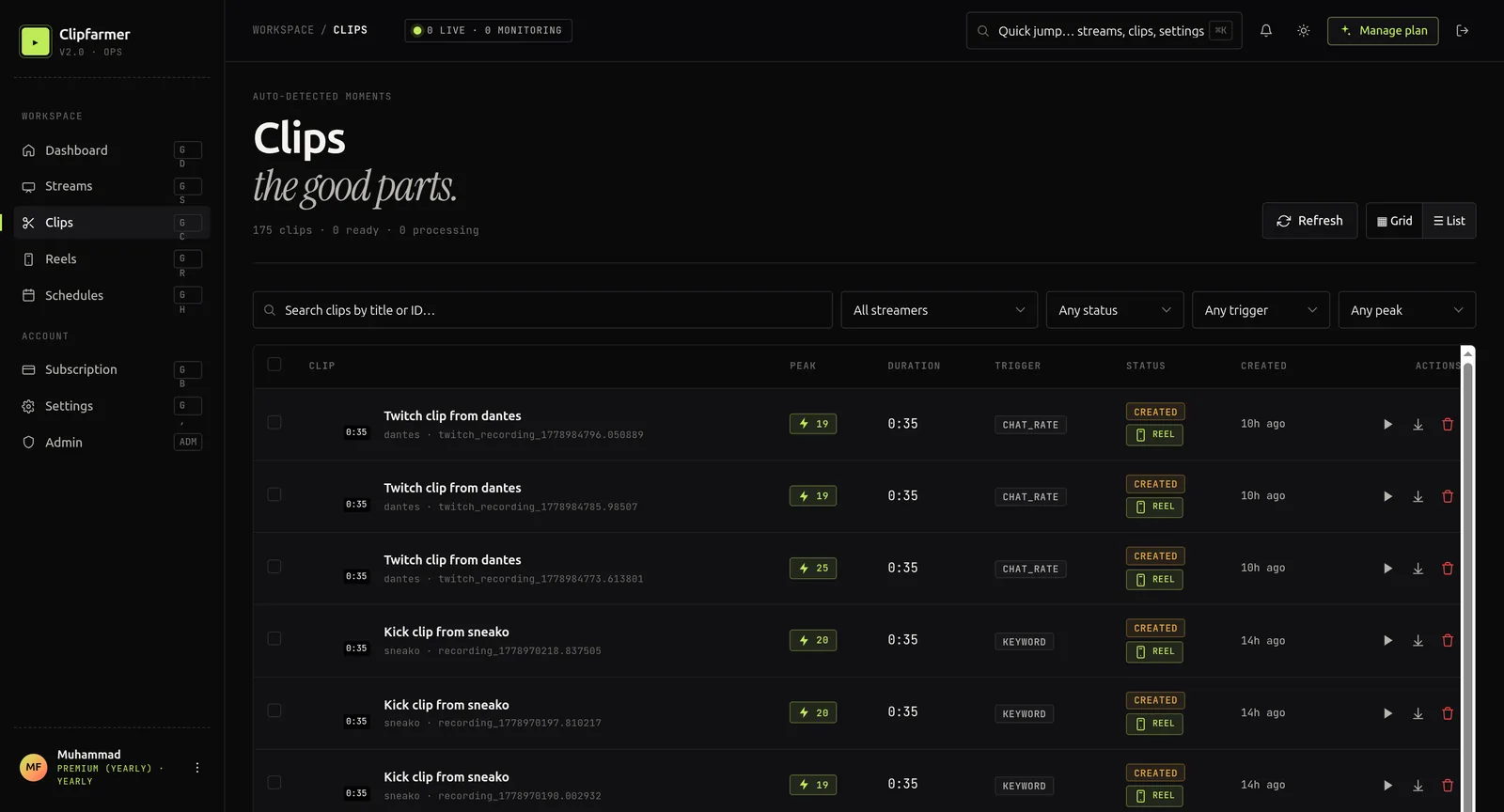
ClipFarmer is an automated clipping tool that watches a creator's streams and turns the best moments into ready-to-post short clips. It gives individual creators the same clip output that large clipping companies build entire freelance networks to produce.
Why clipping works as marketing
What makes clipping companies so effective? The answer lies in authenticity—or at least, the appearance of it.
- Clips look like organic user-generated content rather than advertisements
- Viewers have been trained to skip content that looks like ads
- A clip looks organic, so it performs like an organic content piece
- Traditional advertising CPM rates can't compete with the cost-effectiveness of clipping
"A clip looks organic, so it performs like an organic content piece." — Leon Abboud, founder and CEO of crypto marketing firm Unfungible
Which clipping companies dominate the industry?
The clipping company landscape has exploded with players ranging from startups to billion-dollar platforms.
The clipping marketplaces and reward platforms
Whop is the largest clipping ecosystem, pushing over 3.5 billion clipped views in a single month. The platform boasts $2.67 billion+ lifetime GMV and a $1.6 billion valuation after Tether's strategic investment. Whop has become the go-to marketplace for clipping gigs alongside other digital work.
Vyro is MrBeast's own clipping platform, launched in October 2025. The platform pays roughly $3 per thousand views with no audience required. Vyro has generated 2 billion views and paid out over $1 million, including a $300,000 Beast Games reward pool. The platform allows fans to make money creating short clips from MrBeast's shows, with payouts sent hourly to PayPal, bank accounts, or cryptocurrency.
Clipping.io is a performance network skewed toward creator and crypto brands, with over $1.5 million paid to clippers.
The clipping agencies (managed distribution)
Clipping Culture is the flagship agency, with 10 billion+ views and 100,000+ clippers, serving clients including Universal Music and HBO Max.
Clipping Agency offers done-for-you distribution that recruits and vets editors and handles payouts, with 2 billion+ client views.
Cliptic.co has worked with various crypto casinos and influencers, generating millions of views via clipping campaigns.
AI clipping companies
The rise of artificial intelligence has spawned a new category of clipping companies:
OpusClip is the category leader with 16 million+ creators, a $215 million valuation, and the ability to turn one long video into dozens of captioned, reframed clips.
Vizard is a team and enterprise play with text-based clip editing and approval workflows, 10 million+ users, and clients including Google.
Submagic offers caption styling and one-click shorts, with 4 million+ users and support for 48 languages, serving clients including Shopify.
Wisecut is trusted by 1 million+ creators and media teams to automatically turn long-form and live video into viral clips at scale.
Clouted raised $7 million to automate short video clipping and distribution for brands, using AI and a network of over 100,000 gig creators.
Clipping company vs. clipping service: what's the difference?
While the terms are often used interchangeably, there are important distinctions:
| Aspect | Traditional Media Monitoring Company | Modern Social Media Clipping Company |
|---|---|---|
| Purpose | Track brand mentions, public sentiment, competitor activity | Drive engagement, views, and traffic to longer content |
| Output | Reports, summaries, analysis | Short video clips for social platforms |
| Method | Automated scanning of print, broadcast, digital media | Manual or AI-assisted extraction of video segments |
| Clients | PR firms, corporations, government agencies | Creators, brands, influencers, celebrities |
| Payment | Subscription/retainer fees | Performance-based (per view) |
A "clipping agency" and a "clipping agent" sound adjacent, but they are not the same. One is a service you hire; the other orchestrates the entire production and distribution loop.
Who uses clipping companies?
The answer to what is a clipping company becomes clearer when you look at who's using them:
Content creators & YouTubers
MrBeast employs more than a thousand clippers to put short versions of his videos in front of online audiences and steer them to his YouTube channel. Other major creators like IShowSpeed and Plaqueboymax also use clipping services.
Music industry
As Dante Smith, senior vice president at Capitol Music Group and head of Motown Digital, explains: Clipping is "a way to promote your artists through an organic UGC (user-generated content) format." Record labels like OVO are listed as clients.
Fintech & crypto companies
Clipping has become "the preferred marketing channel for a growing number of fintech and crypto companies". Brands hire independent freelancers to extract engaging segments from podcasts, livestreams, or interviews.
Streaming platforms & studios
Studios are hiring TikTok creators to sell their movies. Airrack's ClipFarm lists HBO Max as a client for "Paul American," and Whop ran a campaign seeding clips of Luc Besson's "Dracula" on TikTok.
Enterprise brands
James, operator of the viral X account Internet Hall of Fame, told Digiday that he had made roughly $60,000 through clipping in the past seven months, working with companies in the billions of dollars of market cap.
How big is the clipping industry?
The clipping industry has grown astonishingly fast:
- Clipping.net has 62,000 clippers earning an average of $3,000 per month
- Cluely, an AI startup, has hired over 700 clippers as part of its growth strategy
- Whop now lists clipping gigs alongside other digital work
- Agencies like Clipping Culture and Lumina Clippers manage campaigns for enterprise clients
- The industry has generated over $7 million in sales and helped clients gain hundreds of thousands of followers in a month
"People used to buy commercials on TV, billboards, radio time slots. Clipping is that for the modern era." — Anthony Fujiwara
Real-world earnings: what clippers make
The economics of clipping companies create substantial earning potential:
- One clipper, Faisal Ali (23, based in Pakistan), earned $600 making clips for MrBeast and even hired two subcontractors
- One clipper made roughly $60,000 through clipping in seven months
- Top clippers can earn $20,000 to $30,000 per month
How do clipping companies create viral content with the "hook" strategy?
The key to successful clipping is identifying a "hook"—something in the first one to two seconds of video that grabs attention.
As one clipper explained: "Think of it like fishing." The hook needs to:
- Pop out at viewers instantly
- Inspire questions or curiosity
- Seem particularly unusual, controversial, or exciting
This is why clipping companies provide detailed campaign instructions to their clippers. In one MrBeast campaign, instructions required that a character from Amazon's "King of Meat" video game appear under the clip—a sponsorship requirement.
What does AI mean for the future of clipping companies?
Artificial intelligence is transforming how clipping companies operate. AI tools now use technologies like Whisper for transcription and LLMs to score and detect viral moments.
The AI clipping revolution
AI clipping companies are emerging as major players:
- OpusClip automatically generates clips from long videos with one click
- Wisecut transforms hours of content into high-performing clips for YouTube Shorts, TikTok, and Instagram Reels
- Clouted uses AI to determine the best social media platform and target audience for each clip
The professionalization of the industry
What began as fan culture has professionalized rapidly in the past two years. Marketplaces, agencies, and performance-based payment structures are creating a legitimate career path for clippers.
Challenges and criticism
Critics argue that clipping doesn't just repackage content—it rewires incentives across the creator economy, rewarding outrage, volume, and manipulation over substance. Concerns about authenticity and the future of online content continue to grow as clip-farming accounts become more prevalent on social media platforms.
"It's advertising that looks like authentic organic fandom." — Cecilia D'Anastasio, Bloomberg digital culture reporter
How do you choose a clipping company?
If you're considering using a clipping company, here's what to look for:
For traditional media monitoring
- Coverage: Does the service monitor all relevant channels (print, broadcast, digital, social)?
- Speed: How quickly are mentions delivered?
- Analysis: Does the service provide sentiment analysis, trend identification, and actionable insights?
- Integration: Can the data be integrated with your existing PR and marketing tools?
For social media clipping
- Network Size: How many clippers does the company have access to?
- Platform Reach: Which platforms do they distribute to (TikTok, Instagram Reels, YouTube Shorts)?
- Performance Metrics: How is success measured and paid for?
- Quality Control: What guidelines are provided to clippers to ensure brand alignment?
Top clipping platforms for 2026
According to industry analysis, and worth weighing alongside our own Twitch vs Kick for clips breakdown when you pick where to source footage:
- Vyro ($3 CPM, MrBeast-backed) — Best Overall for New Clippers
- Whop — Best for Affiliate Clippers
- Facebook Reels — Highest native CPM (~$4)
What does the future of clipping companies look like?
The clipping industry continues to evolve rapidly. Here are the trends shaping its future:
Brands will make performance clipping a standard ad line item
As clipping proves its effectiveness, more brands will allocate budget to this channel.
AI will democratize clipping
AI tools will make clipping accessible to anyone, reducing the barrier to entry and potentially changing the economics of the industry.
Regulatory scrutiny will increase
As clipping becomes more prevalent, questions about disclosure and authenticity will likely lead to regulatory attention.
The industry will continue to consolidate
Major players like Whop and Vyro will continue to grow, while smaller agencies may be acquired or squeezed out.
Frequently asked questions about clipping companies
What is a clipping company in simple terms?
A clipping company is a business that provides media-related services—either monitoring traditional media for mentions or orchestrating the creation and distribution of short-form video clips for social media.
What is a clipping company vs a clipping service?
A "clipping company" and "clipping service" are often used interchangeably. A "clipping agency" specifically handles video clipping, editing, packaging, and posting on behalf of clients.
What is a clipping company in social media?
In social media, a clipping company manages networks of freelance editors who extract short segments from longer videos and distribute them across platforms like TikTok, Instagram Reels, and YouTube Shorts.
How do clipping companies make money?
Clipping companies charge clients subscription fees (typically $2,500 to $10,000 per month) and pay clippers based on performance—usually $1 to $5 per thousand views.
What is a clipping company example?
Examples include Clipping (the LA startup), Whop (the largest clipping ecosystem), Vyro (MrBeast's platform), and Clipping Culture (a major agency).
Do clipping companies pay well?
Yes. Top clippers can earn $20,000 to $30,000 per month, and clipping companies themselves generate millions in revenue.
Conclusion: the two faces of clipping companies
So, what is a clipping company? The answer has two parts.
In its traditional form, a clipping company is a media monitoring organization that tracks brand mentions, news coverage, and public sentiment across print, broadcast, and digital media. These companies have existed since the 1850s and remain essential for PR professionals, corporations, and government agencies.
In its modern form, a clipping company is a marketing engine that harnesses armies of independent creators to extract and distribute short-form video content across social media platforms. This is the clipping company of the MrBeast era—a $7 million+ industry that has fundamentally changed how content is discovered and consumed.
Both definitions are valid. Both are thriving. And both point to the same underlying truth: in a world drowning in information, clipping companies help people find what matters.
Whether you're a brand looking to monitor your reputation or a creator trying to go viral, understanding what is a clipping company is the first step toward leveraging one of the most powerful tools in modern media.