What Is Clipping and How Does It Work? A Step-by-Step Guide

If you've ever scrolled through TikTok, Instagram Reels, or YouTube Shorts and wondered what is clipping and how does it work, you're witnessing one of the most powerful marketing forces in modern media. Clipping has transformed from a niche fan activity into a multi-million-dollar industry that fuels the biggest names in entertainment, fintech, and beyond.
In this comprehensive guide, we'll break down exactly what clipping is, how it works step by step, the strategies behind viral clips, and how both individuals and companies are leveraging this phenomenon to dominate social media.
What Is Clipping? The Core Definition
At its simplest, clipping is the practice of taking a short segment from a longer piece of video content and repurposing it for distribution across social media platforms.
As Bloomberg digital culture reporter Cecilia D'Anastasio explains: "Clipping involves clipping a short segment of a longer video and editing it with some fun text or a description of what's happening. And then you just scatter that across the internet - Instagram Reels, TikTok, anywhere you would look for short-form video."
But there's more to it than that. Clipping has evolved into a sophisticated marketing technique where paid editors—sometimes numbering in the thousands—extract the most engaging moments from long-form content and distribute them across multiple platforms to drive views, engagement, and traffic back to the original content.
Key Insight: Clipping is essentially "advertising that looks like authentic organic fandom." It's a way to buy space and time on people's phones while they scroll.
How Did Clipping Emerge?
Clipping first emerged as a marketing tactic in livestreaming, where independent contractors, or "clippers," were hired to pull out the most engaging bits of content from hours-long streams to build a streamer's presence across social media.
The practice grew out of fan culture—music listeners clipping concert footage, podcast fans sharing their favorite moments. But in the past two years, it has professionalized rapidly. Today, it's a legitimate clipping service industry with marketplaces, agencies, and performance-based payment structures.
Several people interviewed for industry articles have cited streamers like Druski, Andrew Tate, Adin Ross, and Kai Cenat as clipping's first major beneficiaries. The music industry found a way in by booking artists on popular livestreams, which would then be clipped and seeded across platforms like TikTok, YouTube Shorts, Instagram, and X.
How Does Clipping Work Step by Step?
The Traditional Manual Process
Here's how a typical clipping operation works from start to finish:
Step 1: Source Content Acquisition
The process begins with long-form video content. This could be:
- Podcasts (30-90 minute episodes)
- Livestreams (hours-long broadcasts on Twitch or YouTube)
- Interviews (recorded conversations)
- Full-length YouTube videos (10-30 minute productions)
- Concert footage or live performances
- Webinars or training sessions
Clipping services accept content through various methods: uploading video files directly, pasting YouTube or Twitch links, or selecting from a media library.
Step 2: Identifying the "Hook"
This is the most critical step. The key to successful clipping is identifying a "hook"—something in the first one to two seconds of video that grabs attention.
As one clipper explained: "Think of it like fishing." The hook needs to:
- Pop out at viewers instantly
- Inspire questions or curiosity
- Seem particularly unusual, controversial, or exciting
- Make viewers want to keep watching
Clippers look for moments that deliver strong emotional reactions—wild reactions, epic wins, funny laughs, or even controversial moments that spark debate.
Step 3: Extraction and Editing
Once the hook is identified, the clipper extracts that specific segment from the longer video. This involves:
- Determining the exact start and end times for the clip
- Cutting the segment without altering the source media
- Adding visual enhancements like text overlays, captions, and descriptions
- Applying aspect ratio adjustments (typically 9:16 for vertical mobile viewing)
- Adding branded elements if required by the campaign
Modern clipping often uses AI-powered tools that can automatically detect highlights, generate captions, and even suggest optimal clip lengths.
Step 4: Distribution
The finished clip is then distributed across multiple short-form video platforms:
- TikTok
- Instagram Reels
- YouTube Shorts
- X (formerly Twitter)
- Facebook Reels
This distribution is often done from unbranded accounts that appear to be organic fan accounts rather than official brand channels.
Step 5: Performance Tracking and Payment
Clippers are paid based on the performance of their clips. The standard model is performance-based pay:
- Typically $1 to $5 per thousand views
- Some campaigns pay as low as $0.20 per thousand views
- MrBeast's team has paid $50 for every 100,000 views
- Top clippers earn $300 to $1,500 for every 1 million views
How Does AI Clipping Work?
Artificial intelligence has transformed the clipping process, making it faster and more accessible than ever before.
The AI Clipping Workflow
AI clipping tools like OpusClip, Pictory AI, and open-source alternatives have streamlined the process:
Step 1: Video Input
You upload a long-form video or paste a link from YouTube, Zoom, Loom, Google Drive, Dropbox, Twitch, or other sources.
Step 2: AI Analysis
The AI analyzes the video using multiple technologies:
- Transcription (often using Whisper or similar speech-to-text technology)
- Scene detection to identify natural breaks and transitions
- Keyword and emphasis detection to find important moments
- Virality scoring to predict which segments are most likely to perform well
Step 3: Highlight Identification
The AI automatically identifies potential highlights based on:
- Spoken keywords that match your topic or campaign goals
- Emotional peaks in the audio
- Scene changes that indicate new topics or segments
- Manual selections you can make by highlighting specific text in the transcript
Step 4: Clip Generation
The AI generates short video clips from the identified highlights. Each clip includes:
- Synced visuals
- Automatically generated captions
- Scene transitions
- Face-centered cropping for vertical formats
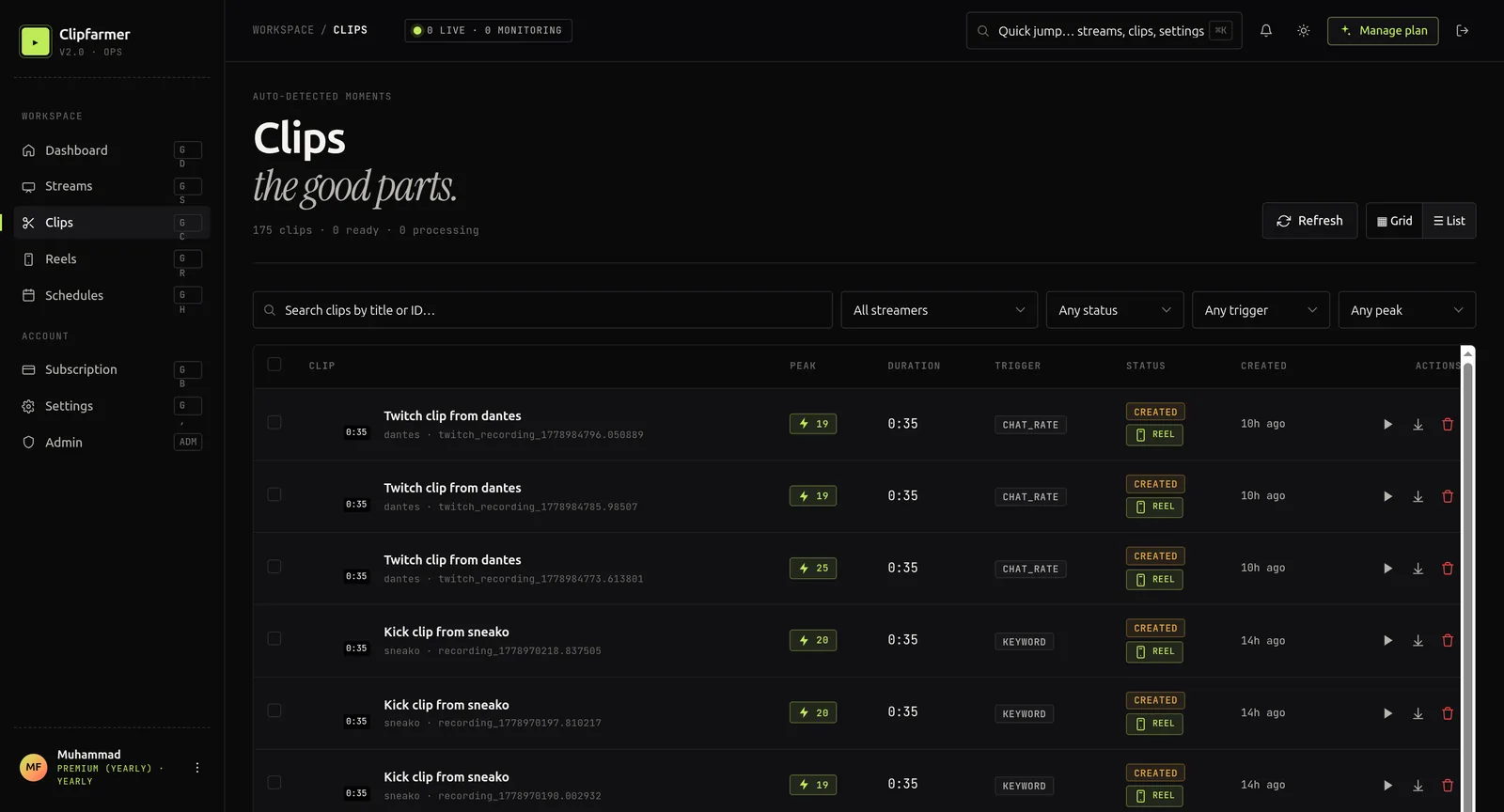
This is exactly the kind of moment detection ClipFarmer is built for. It watches Twitch and Kick streams as they happen and flags the spikes in chat energy that signal a clip-worthy moment, so you never have to scrub through hours of VOD to automatically clip Twitch streams.
Step 5: Customization and Export
You can then:
- Edit each clip individually
- Add background music or AI voiceovers
- Insert text overlays or callouts
- Apply brand kits for consistent logos, fonts, and colors
- Export in multiple aspect ratios (9:16, 1:1, 16:9)
Advanced AI Capabilities
Some AI clipping tools offer even more sophisticated features:
ClipAnything (OpusClip): Allows users to generate clips simply by describing the moments they wish to capture using natural language prompts.
Autonomous Scouting: Some AI pipelines can autonomously search, filter, score, and rank video candidates, evaluating multiple finalists before committing to a single winner.
Multimodal AI: Tools like GitHub's Clip-Anything can extract any moment from any video using natural language prompts—just describe what you're looking for, and AI will find and clip it for you. This same approach powers AI storytelling for faceless videos, where the editing happens without a creator ever appearing on camera.
How Are Viral Clips Made With the Hook Strategy?
Understanding how clipping works means understanding the psychology behind what makes a clip go viral.
What Makes a Good Hook?
The hook is the first one to two seconds of a video. It's what stops a user from scrolling past. Effective hooks typically:
- Create curiosity - Make viewers wonder what happens next
- Deliver shock value - Show something unexpected or extreme
- Spark emotion - Make viewers feel something (excitement, anger, amazement)
- Ask a question - Make viewers want the answer
- Show conflict - Present opposing viewpoints or drama
The Clip Farming Strategy
Clip farming takes this a step further. It refers to intentionally manufacturing moments during a live broadcast specifically to create short, viral clips.
Unlike natural highlights, clip farming is premeditated. The streamer structures parts of the stream around moments designed to spread across content platforms.
This often includes:
- Exaggerated reactions meant to spark debate
- Staged drama or fake "leaks"
- Public pranks or confrontational interactions
- "Main character" moments built for shock value
The focus isn't the live audience experience—it's the short clip that will circulate afterward. Organic clips happen because something entertaining naturally unfolds. Clip farming happens because the clip is the primary objective.
How Does Clipping Make Money?
To fully understand what is clipping and how does it work, you need to understand the economics behind it.
The Three-Tier Model
1. Clients (Brands and Creators)
Clients pay clipping companies for distribution services. These include:
- YouTube creators like MrBeast (who employs more than a thousand clippers)
- Record labels (OVO is listed as a client)
- Streamers like IShowSpeed and Plaqueboymax
- Fintech and crypto companies
- Podcasters and media companies
Clients pay subscription fees of $2,500 to $10,000 per month, and sometimes more.
2. Clipping Companies (Agencies and Platforms)
Clipping companies manage the distribution network. Examples include:
- Clipping (LA startup) - generated $7.7 million in sales in a single year
- Whop - the largest clipping ecosystem with $2.67 billion+ lifetime GMV
- Vyro - MrBeast's own clipping platform
- Clipping Culture - 100,000+ clippers, 10 billion+ views
These companies maintain stables of clippers. Clipping, for example, has 23,300 clippers on its roster.
3. Clippers (Individual Creators)
Clippers are the independent contractors who actually create and post the clips. They are paid based on performance:
- $300 to $1,500 per 1 million views
- $50 per 100,000 views (MrBeast campaigns)
- $1 to $5 per 1,000 views (typical rates)
- Some top clippers earn $20,000 to $30,000 per month
One clipper, Faisal Ali (23, based in Pakistan), earned $600 making clips for MrBeast and even hired two subcontractors.
Who Uses Clipping and Why?
Content Creators and YouTubers
The most prominent example is MrBeast, who employs more than a thousand clippers to put short versions of his videos in front of online audiences and steer them to his YouTube channel. This drive to grow an audience is a big part of why people clip others in the first place.
The Music Industry
As Dante Smith, senior vice president at Capitol Music Group and head of Motown Digital, explains: Clipping is "a way to promote your artists through an organic UGC [user-generated content] format." The music industry found that booking artists on popular livestreams, then clipping and seeding those moments across platforms, was incredibly effective.
Fintech and Crypto Companies
Clipping has become "the preferred marketing channel for a growing number of fintech and crypto companies." Brands hire independent freelancers to extract engaging segments from podcasts, livestreams, or interviews.
Podcasters
Podcasts have become video-first specifically because creators needed something to put on TikTok, Reels, and YouTube Shorts.
Talent Agencies
United Talent Agency, one of the biggest talent agencies in Beverly Hills, uses clipping.
The Economics at a Glance
| Role | What They Do | How They Get Paid |
|---|---|---|
| Clients | Pay for clipping services | N/A (they pay) |
| Clipping Companies | Manage clipper networks | $2,500-$10,000/month subscriptions |
| Clippers | Create and post clips | $1-$5 per 1,000 views |
What Are the Tools of the Trade?
AI-Powered Clipping Platforms
OpusClip: The category leader with 16 million+ creators and a $215 million valuation. It turns one long video into dozens of captioned, reframed clips.
Pictory AI: Automatically detects important segments from transcripts and creates short video clips with synced visuals, captions, and scene transitions.
Wisecut: Trusted by 1 million+ creators and media teams to automatically turn long-form and live video into viral clips at scale.
Clouted: Raised $7 million to automate short video clipping and distribution for brands.
Open-Source Options
igedits: A self-hosted, AI-powered video clipping tool—an open-source alternative to OpusClip.
shorts-clipper: An AI-powered video clipping pipeline that scouts trending content, extracts highlights, generates subtitles, and automatically publishes Shorts, Reels, and TikToks.
Clipping vs. Clip Farming: What's the Difference?
Clipping (Legitimate Marketing)
- Purpose: To promote content and drive traffic to original sources
- Approach: Strategic, targeted distribution
- Disclosure: Often includes proper disclosures
- Quality: Focuses on genuinely engaging moments
Clip Farming (Controversial Practice)
- Purpose: To generate views for their own sake
- Approach: Spams content across social without a real strategy
- Disclosure: Often lacks proper disclosure about paid promotion
- Quality: May manufacture moments specifically for virality
Where clipping gets murky is when it falls into a "clip farming" practice that just spams content across social without a real strategy or true disclosure.
Frequently Asked Questions About Clipping
What is clipping in simple terms?
Clipping is taking a short, engaging segment from a longer video and posting it on social media platforms like TikTok, Instagram Reels, and YouTube Shorts.
What is clipping and how does it work step by step?
The process involves: 1) Source content acquisition, 2) Identifying a "hook" (the first 1-2 seconds), 3) Extraction and editing with captions/text, 4) Distribution across platforms, 5) Performance tracking and payment based on views.
What is the purpose of clipping people?
The purpose is promotion—driving attention to content creators, artists, brands, and personalities by making their content more discoverable in short-form formats.
What does a clip farmer mean?
A clip farmer is someone who systematically creates and distributes clips, sometimes manufacturing moments specifically to go viral rather than capturing organic highlights.
Do clip farmers make money?
Yes. Top clippers can earn $20,000 to $30,000 per month, with some making $60,000 in seven months.
How to get paid for clipping?
Clippers are typically paid on a performance basis—$1 to $5 per thousand views, or $300 to $1,500 per million views.
How does AI clipping work?
AI clipping tools analyze video content using transcription, scene detection, and virality scoring to automatically identify and extract the most engaging moments, then generate captioned clips ready for social media.
What Is the Future of Clipping?
The clipping industry continues to evolve rapidly. Here are the trends shaping its future:
1. AI Will Democratize Clipping
AI tools are making clipping accessible to anyone, dramatically reducing the barrier to entry.
2. Brands Will Make Clipping a Standard Ad Line Item
As clipping proves its effectiveness, more brands will allocate budget to this channel.
3. Professionalization Will Continue
What began as fan culture has professionalized rapidly in the past two years. Marketplaces, agencies, and performance-based payment structures are creating a legitimate career path for clippers.
4. Regulatory Scrutiny Will Increase
As clipping becomes more prevalent, questions about disclosure and authenticity are leading to regulatory attention.
5. The Industry Will Continue to Consolidate
Major players like Whop and Vyro will continue to grow, while smaller agencies may be acquired or squeezed out.
Conclusion: Understanding the Clipping Revolution
So, what is clipping and how does it work?
Clipping is the practice of extracting short, engaging segments from longer video content and distributing them across social media platforms. It works through a combination of strategic content selection, editing, and performance-based distribution that rewards clippers for generating views.
But clipping is more than just a technical process. It represents a fundamental shift in how content is discovered and consumed. As Anthony Fujiwara, founder of Clipping, put it: "People used to buy commercials on TV, billboards, radio time slots. Clipping is that for the modern era. It's buying space and time on people's phones while they scroll."
Whether you're a brand looking to expand your reach, a creator trying to grow your audience, or an individual looking to earn money as a clipper, understanding what is clipping and how does it work is the first step toward leveraging one of the most powerful tools in modern media.
The internet has been "TL;DR-ified." Everything we make gets truncated down to short-form content designed for discovery. And right now, the way to get people to discover content is to make clips of it—no matter what it is.