What Is the Purpose of Clipping People?

If you've ever scrolled through TikTok, Instagram Reels, or YouTube Shorts and wondered what is the purpose of clipping people, you're witnessing one of the most transformative marketing forces in modern media. From MrBeast's thousand-plus clippers to the music industry's coordinated campaigns, clipping people has become the go-to strategy for brands, creators, and celebrities looking to dominate the attention economy.
In this comprehensive guide, we'll break down exactly why people clip others, the strategic purposes behind the practice, and how it's reshaping the way we discover content, build audiences, and make money online.
What is the core purpose of clipping people?
At its simplest, the purpose of clipping people is promotion — using short, engaging video segments to drive attention, build audiences, and generate revenue for the person being clipped. If you want to understand the mechanics first, here's how clipping works.
As Bloomberg digital culture reporter Cecilia D'Anastasio explains: "This is a modern marketing technique for the digital media era. This is advertising that looks like authentic organic fandom."
But the purposes run far deeper than simple promotion. Clipping people serves multiple strategic functions:
- Discovery and audience growth – Helping people find content they wouldn't otherwise see
- Marketing and brand building – Promoting products, artists, and personalities
- Monetization – Creating revenue streams for both clippers and those being clipped
- Community and fan engagement – Building parasocial relationships
- Algorithm optimization – Gaming social media algorithms for maximum reach
As Anthony Fujiwara, the 23-year-old founder of the clipping agency Clipping, put it: "People used to buy commercials on TV, billboards, radio time slots. Clipping is that for the modern era. It's buying space and time on people's phones while they scroll."
How does clipping drive discovery and audience growth?
The discovery problem
One of the primary purposes of clipping people is solving a fundamental problem: people don't have time for long-form content.
As NPR's Scott Detrow observed: "One problem with being a YouTube creator or anybody else who wants to make long-form videos is, look, the rest of us don't have time for all of that. Too much life is happening."
The solution? Put shorter video excerpts on social media. "They're much more likely to go viral and bring people to your work."
How clipping drives discovery
Clipping people works as a discovery mechanism because:
- Shorter content is more shareable – A 20-second clip spreads faster than a 20-minute video
- Algorithms favor short-form – Platforms like TikTok, Instagram Reels, and YouTube Shorts actively promote short content
- Clips create curiosity – A compelling hook makes viewers want to find the full content
- Multiple entry points – One hour of content can become dozens of discovery opportunities
As Vox put it: "It truncates everything we make and it all goes down to 'We need a way for people to discover our content.' And right now, the way to get people to discover the content is to make clips of it, no matter what it is." For streamers, the practical playbook is to get more clips organically so each broadcast keeps surfacing new viewers.
The MrBeast example
The most prominent example of clipping for discovery is MrBeast, who employs more than a thousand clippers to put short versions of his videos in front of online audiences and steer them to his YouTube channel, which boasts 448 million subscribers.
For a recent campaign, MrBeast's team paid independent editors $50 for every 100,000 views that snippets of his YouTube shows got on social media apps.
How is clipping used for marketing and brand building?
Advertising that doesn't look like advertising
The core marketing purpose of clipping people is creating advertising that looks like authentic organic content.
As Leon Abboud, founder and CEO of crypto marketing firm Unfungible, explained: "People have been trained to skip content that looks like ads. A clip looks organic, so it performs like an organic content piece."
This is critical because:
- Viewers have ad blindness – they scroll past traditional ads
- Clips blend in with organic content in feeds
- Clips feel authentic – like a fan sharing something they love
- Clips generate higher engagement than traditional advertising
Clipping as the new TV commercial
Fujiwara's framing of clipping as "buying space and time on people's phones while they scroll" captures the marketing purpose perfectly. Just as brands once bought 30-second TV spots, they now buy 15-second clips that appear in social media feeds.
Industry-wide adoption
The marketing purpose of clipping people has been adopted across industries:
Music Industry: As Dante Smith, senior vice president at Capitol Music Group and head of Motown Digital, stated: Clipping is "a way to promote your artists through an organic UGC (user-generated content) format."
Sam Alavi, manager of the artist Bbno$, told Variety: "I don't know anybody not utilizing [clipping] who's actually competitive in the marketplace."
Fintech and Crypto: Clipping has become "the preferred marketing channel for a growing number of fintech and crypto companies."
Mainstream Brands: Companies like Taco Bell, DoorDash, and Cricket Wireless have used clipping as a marketing tactic. Even Coinbase and Lionsgate now regularly hire internet creators to chop up executive interviews and keynotes into quick vertical videos.
Hollywood Studios: "Clipping is a way for the Hollywood studios she works with to tap into younger audiences," said Aida Andersson, head of commercial at UGC games media company Chartis.
How does clipping create monetization and revenue?
The economics of clipping people
Clipping people isn't just about attention — it's about money. The purpose extends to creating revenue streams for everyone involved.
For the person being clipped
- Increased viewership on their primary platforms
- Higher ad revenue from more views
- More sponsorship opportunities from larger audiences
- Greater brand value and negotiating power
For the clippers
Clippers are paid based on performance, typically between $1 and $5 per thousand views. Some campaigns pay as low as $0.20 per thousand views.
Real earnings examples:
- One clipper made roughly $60,000 through clipping in seven months
- Top clippers can earn $20,000 to $30,000 per month
- Faisal Ali, 23, based in Pakistan, earned $600 making clips for MrBeast
- Emrah Bayraktar from Belgium made $2,500 in two weeks and quit his jobs
For the clipping companies
The clipping company Clipping generated $7.7 million in sales in a single year. Clients pay subscription fees of $2,500 to $10,000 per month, and sometimes more. If you're evaluating whether to do it yourself or hire help, here's what a clipping service actually delivers.
The scale of the economy
- Clipping.net has 62,000 clippers earning an average of $3,000 per month
- Clipping maintains a stable of 23,300 clippers
- Cluely, an AI startup, has hired over 700 clippers
- Whop pushes over 3.5 billion clipped views in a single month
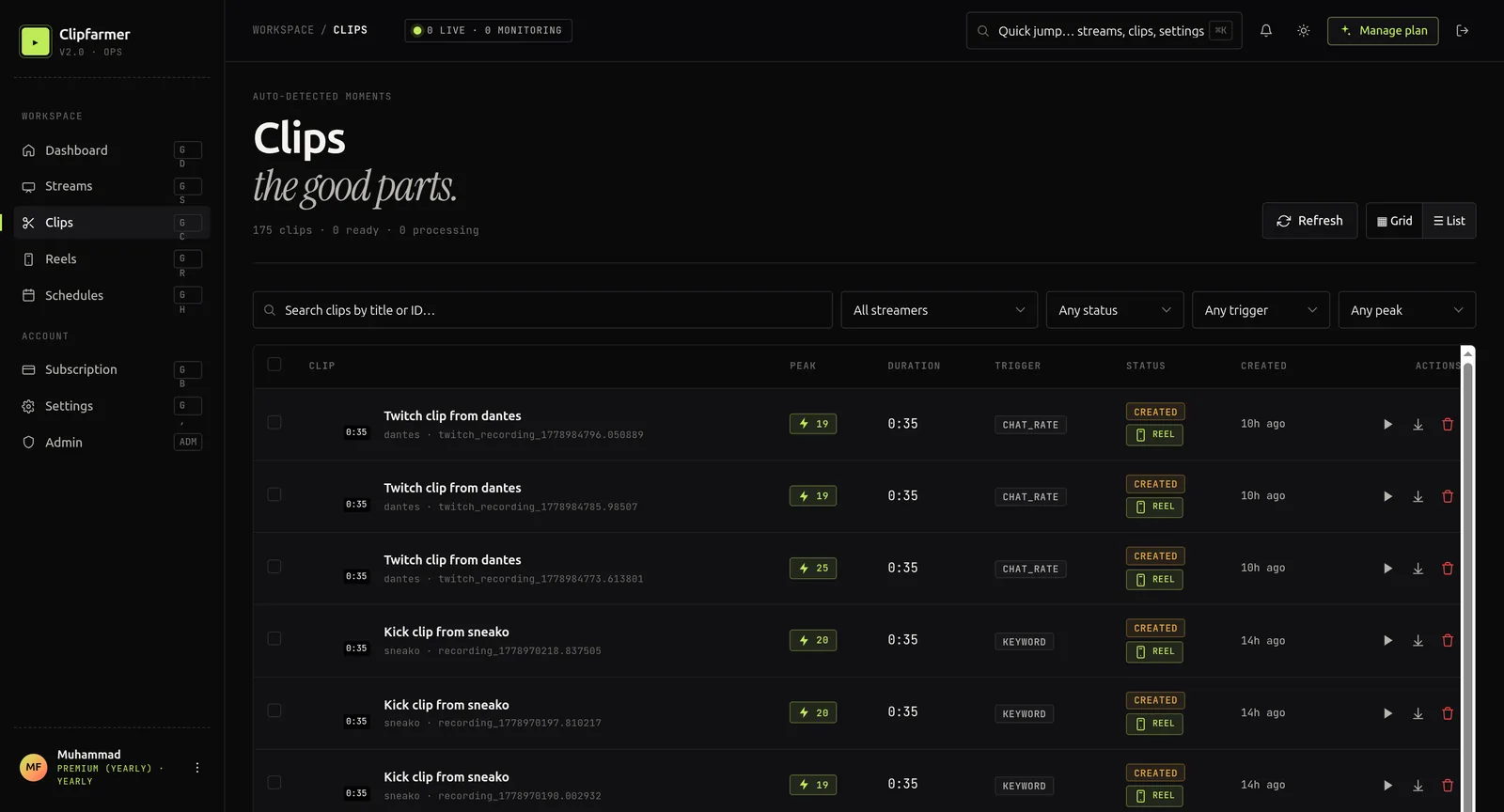
ClipFarmer is an automated clipping tool that detects the moments your audience reacts to most and clips your streams for you. Instead of scrubbing hours of footage, you get the highlights worth posting — the raw material behind every discovery, marketing, and monetization play in this guide.
How does clipping build community and fan engagement?
Parasocial relationships
One of the most powerful purposes of clipping people is building parasocial relationships — the one-sided emotional connections fans form with media figures.
Clipping works as a marketing tool because "it taps into the parasocial relationships between creators and their audiences. Fans see creators as tastemakers and can perceive a shared clip as more meaningful, boosting its viral potential."
Fan-driven clipping
Not all clipping is paid. Some people clip others simply because they're fans.
As CNN reported: "Some clippers clip because they're fans of the person they're clipping, and they want everyone else to share the experience."
This organic fan clipping serves purposes including:
- Sharing joy – "This is amazing, everyone needs to see it!"
- Building community – Creating shared experiences around content
- Showcasing fandom – Demonstrating devotion to a creator or artist
- Creating inside jokes – Meme-ifying moments for communities
The evolution from fan culture to industry
As Forbes noted: "The practice emerged from fan culture (music listeners clipping concert footage, podcast fans sharing their favorite moments) but in the past two years it has professionalized rapidly."
What started as organic fan behavior has become a sophisticated industry, but the underlying purpose remains the same: connecting people through shared content experiences.
How does clipping optimize for algorithms?
Gaming the system
Another key purpose of clipping people is optimizing for social media algorithms.
As The Verge reported: "Clippers are largely anonymous social media accounts whose sole purpose is to rack up views."
How clipping exploits algorithms
- Volume – Posting dozens or hundreds of clips increases the chances of algorithmic pick-up
- Frequency – Algorithms favor accounts that post regularly
- Engagement signals – Clips generate likes, shares, and comments
- Retention – Short clips keep viewers watching, signaling quality to algorithms
The clip farming strategy
Clip farming takes algorithmic optimization to its logical extreme. As defined by Restream: "Clip farming in streaming refers to intentionally manufacturing moments during a live broadcast to create short, viral clips. Unlike natural highlights, clip farming is premeditated."
The purpose of clip farming is simple: reverse-engineer virality. "For some creators, this approach feels strategic — a way to reverse-engineer virality."
The scale of algorithmic gaming
- One creator had 1,600 clippers working on his behalf, generating tens of thousands of videos and billions of views
- A several-hour stream can be cut into hundreds or sometimes thousands of short-form clips
- Dedicated fan accounts and clip farms generate aggregate off-platform views that are often multiples of the original live audience
How does clipping repurpose content efficiently?
Maximizing content value
Another purpose of clipping people is maximizing the value of existing content.
As marketing leaders explain: "Marketers, clipping is just one more way to catch consumers' shrinking attention and to squeeze every drop of value from a piece of content."
The efficiency argument
Those who are fans of clipping "consider it a low-lift, high-reward marketing tactic that can take existing content, chop it up, remix it, and make it viral."
Key benefits:
- No new content creation – Repurposing existing material
- No advanced editing skills required – Simple cutting and captioning
- Platform agnostic – Content works across TikTok, Instagram, YouTube Shorts, and X
- Cost-effective – Cheaper than producing new content
Clip farming as efficient distribution
As vidIQ explains: "Clip farming is the systematic process of extracting multiple short-form clips from your existing long-form content and strategically distributing them across platforms to maximize your reach and drive traffic back to your main channel."
"You're taking the hard work you already did and multiplying its impact efficiently."
How does clipping create notoriety and fame?
The notoriety engine
Perhaps the most controversial purpose of clipping people is manufacturing fame.
CNN reported on how clippers can make obscure figures seem well-known: "Clippers harvest dramatic seconds from hours of boring video streams and use those clips to flood platforms where algorithms can make obscure figures seem well-known."
How it works
"Clippers are the middlemen between all the people looking for attention today and the billions of people who are looking for something to pay attention to. They sift through longform material — hourslong podcasts and livestreams that are mostly very boring — and pick out a few seconds of conflict or misadventure or some other drama, then package it into short, shareable video clips. Then they hose down social media sites with these clips." The packaging matters as much as the moment, which is why clip titles that get clicked make or break a clip's reach.
The danger of this purpose
Critics argue that clipping "rewards the most extreme, boundary-pushing behavior, nudging streamers to act out in hopes of going viral."
"The economic incentives created by streaming sites and social platforms reward increasingly extreme behavior to generate shareable clips."
What are the ethics and controversies of clipping people?
Understanding what is the purpose of clipping people also requires understanding the controversies.
Lack of disclosure
One major issue: "Social media clipping is the practice of cutting longer videos into their most interesting, remarkable moments and sharing them from unbranded accounts, often without disclosing that they've been paid to do so."
Context collapse
As Slate reported: "The effect of clipping is context collapse maximized to further a hasty impression of a vaguely famous person. In that environment, the most successful (and profitable) marketing is the most outrageous."
Platform pushback
TikTok and Instagram are cracking down on clipping campaigns that do not clearly disclose payments, hiding those posts from main feeds. Instagram has blocked unoriginal content from its recommendation system.
Frequently asked questions about the purpose of clipping people
What is the purpose of clipping people in simple terms?
The purpose of clipping people is to promote them — using short video clips to drive attention, build audiences, generate revenue, and create buzz across social media platforms.
Why do people clip others on social media?
People clip others for various reasons: some are paid to do it, some are fans who want to share content they love, and some are building careers as clippers earning money from views.
What is the purpose of clipping people for brands?
For brands, clipping people is a marketing tactic — advertising that looks like organic content, designed to reach audiences who have learned to ignore traditional ads.
Do clip farmers make money?
Yes. Top clippers can earn $20,000 to $30,000 per month, with some making $60,000 in seven months.
Is clipping people ethical?
It depends. Ethical clipping involves proper disclosure, original editing, and genuine content. Unethical clipping involves undisclosed payments, misleading edits, and manufactured outrage.
What is the multi-faceted purpose of clipping people?
So, what is the purpose of clipping people? The answer has many dimensions:
- Discovery – Helping audiences find content they wouldn't otherwise see
- Marketing – Advertising that looks like authentic organic fandom
- Monetization – Creating revenue for creators, clippers, and companies
- Community – Building parasocial relationships and fan communities
- Algorithm optimization – Gaming social media algorithms for maximum reach
- Efficiency – Maximizing the value of existing content
- Notoriety – Manufacturing fame and attention
As Anthony Fujiwara said: "Clipping makes it so you have a higher chance to be featured on these phones, instead of someone driving past your content on a billboard, it's now someone swiping past it as they scroll."
The purpose of clipping people is ultimately about capturing attention in an increasingly fragmented media landscape. Whether for fame, fortune, or fandom, clipping has become the primary mechanism for getting noticed in the modern attention economy.
But as the industry matures, the purpose is evolving. The future belongs to those who can navigate the clipping economy "without eroding consumer trust" — combining the power of viral distribution with honesty, originality, and genuine value.