How to Use AI to Tell Powerful Stories Without Showing Your Face
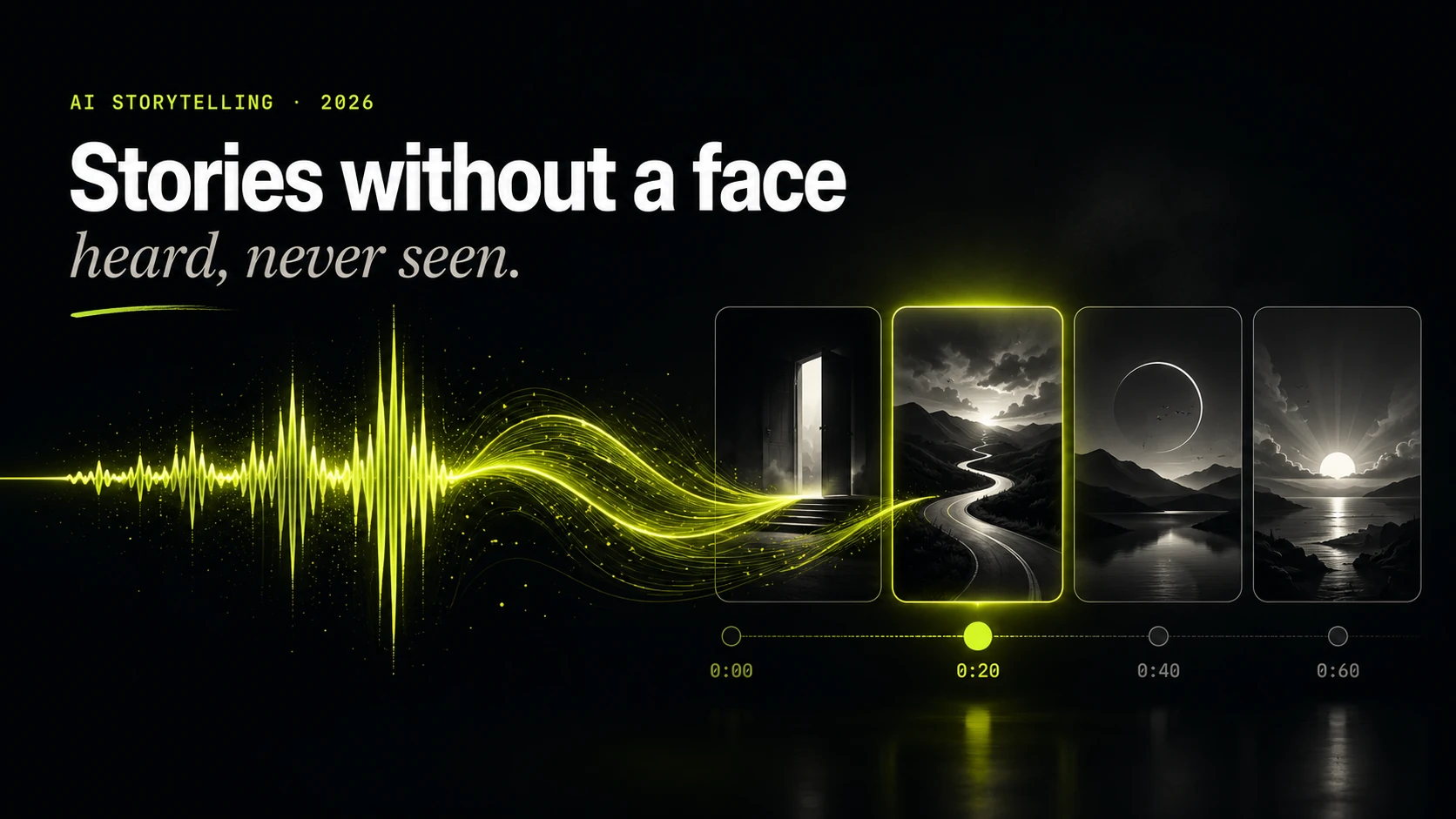
Stories sell. The question is whether you need a charismatic host on screen to tell them. You don't.
AI has opened up a kind of storytelling where the narrator is heard but never seen. From creepy true-crime tales to inspirational origin stories, faceless AI videos are pulling in billions of views across YouTube Shorts, TikTok, and Instagram Reels.
Why does the AI-plus-storytelling combination work so well? AI can generate scripts, voices, and visuals in minutes, viewers project their own emotions onto a faceless narrator, and algorithms love a clear narrative arc of setup, conflict, and resolution.
What is AI storytelling for faceless videos?
It means using generative AI to write the narrative, create or pick the matching visuals, synthesize a natural-sounding voiceover, and edit the sequence, all without anyone appearing on camera.
What are the parts of a faceless story?
Almost every strong faceless video has four moves.
- The hook, in the first three seconds. A question, a bold claim, or a visual mystery. Example: "This $10 tool saved my business," as on-screen text with no face.
- The build. You layer in facts, emotion, or tension while the visuals and music shift underneath.
- The turn. A surprising reveal or counterpoint. Example: "But then everything changed," over a ticking clock.
- The resolution. A clear takeaway or call to action. Example: "Here's the exact template I used," over a screen recording.
AI is fast at generating and matching these beats, especially when you run them through a dedicated faceless video tool like ClipFarmer.
Which AI tools do you need for faceless storytelling?
You don't need a huge stack. A handful of tools covers the whole pipeline.
- Scriptwriting: ChatGPT or Claude. Give it the genre, tone, and length, and it returns story beats.
- Visual search: ClipFarmer's integrated stock search finds free clips by keyword.
- AI video generation: Runway Gen-2 or Pika Labs for visuals that don't exist in any stock library, like a clock melting in a desert.
- Voiceover: ClipFarmer's text-to-speech or ElevenLabs, with a wide range of emotions and languages.
- Captions and effects: ClipFarmer's auto-captions sync to the voice so more people stay to the end.
If you want a shortcut, ClipFarmer's story mode lets you paste a script, pick a genre (mystery, motivational, educational), and get suggested scene transitions and background music automatically.

How do you write a faceless script AI can actually use?
AI takes you literally, so write prompts that describe both the audio and the visuals.
A weak prompt is "tell a story about a lost cat." A strong one spells out the mood and the shots: "Write a 60-second faceless video script. Tone: heartwarming, a little sad, then happy. Visuals: dark alley, then a rainy window, then a child hugging a cat. Audio: soft piano building to uplifting strings. Hook: This cat traveled 200 miles."
A sample script ready for ClipFarmer
Hook (0 to 5 seconds): dark blue screen, text fades in reading "200 MILES." Audio: "A cat named Willow disappeared in 2024. Two years later..." Visual: a blurred map with a red dot moving.
Conflict (6 to 25 seconds): fast cuts of rain, highways, and shelters. Audio: "She crossed three states. No chip, no collar."
Resolution (26 to 45 seconds): a sunrise, a child smiling. Audio: "A microchip finally found her, 200 miles from home. Now she sleeps on the same bed every night."
Call to action (46 to 60 seconds): text reading "SHARE if you believe in miracles."
Paste a script like this straight into ClipFarmer's script editor and the tool suggests visuals based on your keywords.
How do you get the voiceover right?
The voice is the only human element in a faceless video, so it carries a lot. Match it to the genre.
- True crime: deep, slow, slightly breathy, like the ElevenLabs "Adam" voice.
- Motivational: medium pitch, confident, with deliberate pauses, like ClipFarmer's "Energetic Male."
- Children's stories: higher pitch and varied tempo, like ClipFarmer's "Friendly Female."
Use emotional tags
Some AI voices let you drop in tags like (whisper) or (excited). For example: "He opened the door (whisper) and saw nothing there." Little cues like that add drama without a face.
How do you avoid a robotic voiceover?
Use expressive AI voices that support emotion tags, add short pauses between sentences, and vary the speed slightly on key phrases. ClipFarmer lets you adjust pitch and pace sentence by sentence.
How long should each scene be?
Faceless videos lose people the moment the screen sits still for too long. These are rough ceilings.
- Hook: 2 to 3 seconds, with a zoom, pan, or color pop.
- Explanation: 4 to 5 seconds, then cut to new footage or text.
- Emotional peak: 1 to 2 seconds, often a flash of white or black.
- Call to action: 3 to 4 seconds, with text and an arrow.
ClipFarmer can auto-cut your footage to these timings; just choose fast pacing in the settings.
What is the ideal scene length for a faceless story?
For TikTok and YouTube Shorts, keep each scene between two and five seconds. Longer than that and you lose people. Quick cuts and motion graphics hold the energy.
What does a faceless story that gained 2M views look like?
Take a channel like MindFuel, modeled on patterns that actually work, and a 90-second video called "The Fisherman Who Never Existed."
Here is what they did with AI: ChatGPT generated a mystery script with a twist ending. The visuals were about 70% stock (fishing, ocean) and 30% AI-generated, including a floating journal. The voiceover used ClipFarmer's "Mysterious Male" with pause tags. Captions highlighted key words in yellow.
The result: 2.1 million views across Shorts and TikTok, around 7,000 comments (a lot of them asking for part two), and a 12% click-through to their affiliate link for fishing gear.
How do you help a faceless story get discovered?
A few habits make your video easier for platforms and search to understand.
- Publish the full transcript in the description, not just a "link in bio."
- Add timestamps with descriptive labels, like "0:00 the disappearance," "0:30 the search," "0:55 the impossible return."
- Put a two-sentence summary at the top of the description that answers what happens in the video.
A good summary reads like this: "This faceless AI video tells the true story of a cat that traveled 200 miles home over two years. Built from stock footage and an AI voiceover, it is about loyalty and hope."
The takeaway
You don't need a Hollywood budget or a camera-ready face. With AI scriptwriting, voice synthesis, and ClipFarmer's scene matching, you can tell emotional stories that land with people anywhere.
If you want to try it today: pick one emotion (curiosity, hope, or fear), write a four-sentence story using the hook, build, turn, and resolution structure, paste it into ClipFarmer's story mode, then export and post to your best platform.
Curious about the businesses behind viral clips? See what a clipping company is.